Teaching Officers to Develop and Facilitate Scenario-Based Training
We partnered with the Colonie (NY) Police Department to teach officers how to create and facilitate real-world decision-making scenarios.
Domain: Law Enforcement
Focus: Developing officers’ scenario design and facilitation skills
Challenge
Many law enforcement agencies recognize the value of discussion-based scenario-driven decision training exercises such as Tactical Decision Games (TDGs), ShadowBox exercises (SBXs), or Decision Forcing Cases (DFCs) but struggle to create and sustain these kinds of training programs on their own. Organizations often have limited experience designing realistic scenarios that address the cognitive challenges of the actual work being performed and facilitating discussions that uncover expert thinking rather than simply reviewing policies and procedures.
Outcome
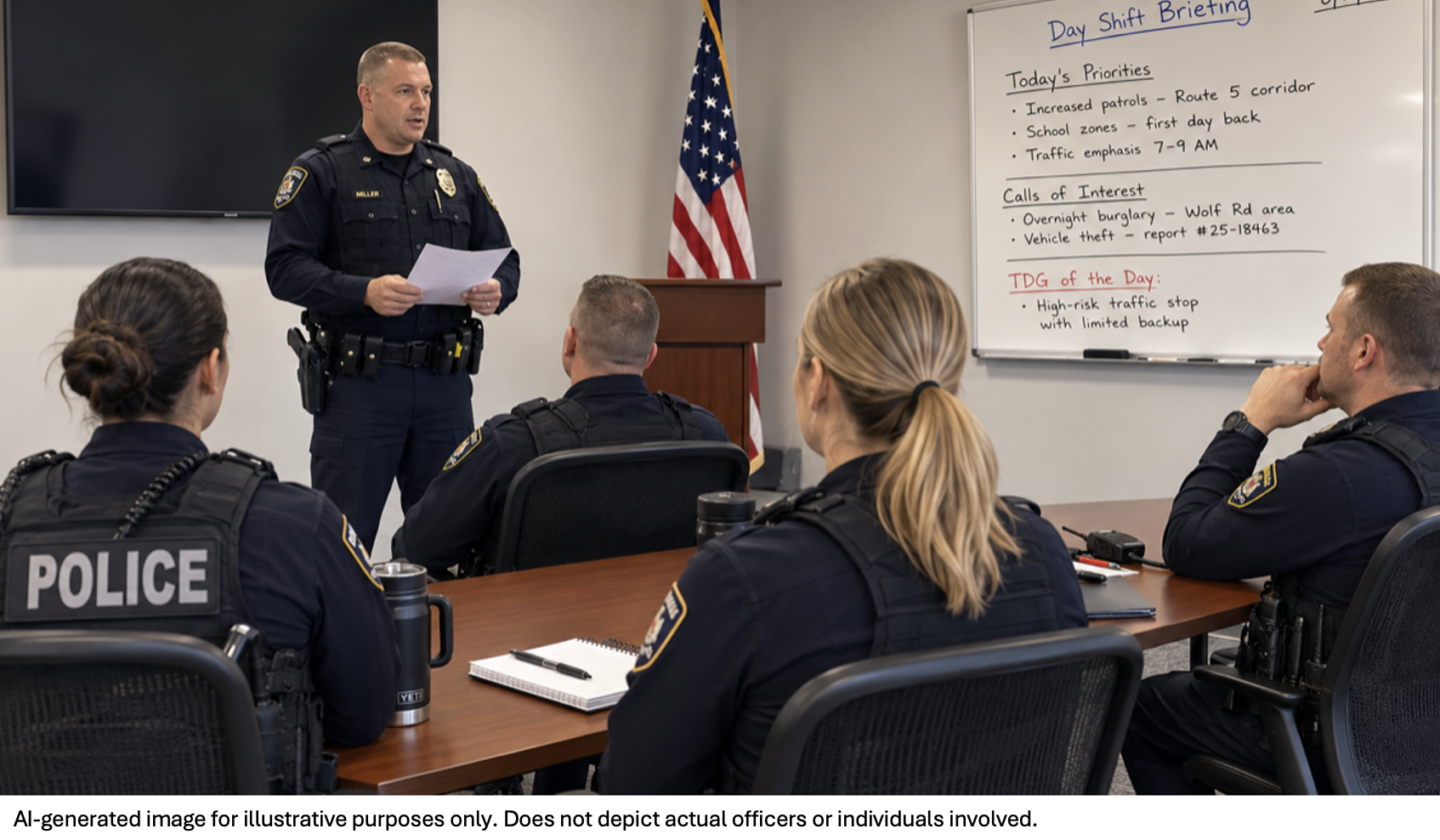
Our team worked with a small group of officers from the Colonie Police Department to increase their skills in designing and facilitating TDGs. With our assistance, officers identified a meaningful incident they experienced in the field and turned it into a TDG. Participants then refined the scenario and practiced facilitating their TDGs with fellow officers, receiving structured coaching and feedback to strengthen both the scenarios and their facilitation.
Impact
By the end of the project, eight Colonie officers were prepared to develop and effectively facilitate TDGs, enabling the agency to continue expanding its library of training scenarios and integrate facilitated discussions into daily briefings. The agency incorporated TDGs into a larger “microdosing” training program that also included a review of procedural knowledge and practical skills (e.g., proper TASER deployment)..
Background and Description
Law enforcement officers routinely make challenging, high-stakes decisions under uncertainty, time pressure, and incomplete information. While traditional training often emphasizes policies, procedures, and tactical skills, decision skills are often neglected during standard training.
Conventional training provides few opportunities to practice the cognitive skills that support effective decision making such as recognizing subtle cues, anticipating consequences, weighing competing priorities, and adapting to changing circumstances. Decision training exercises provide officers with structured opportunities to practice these cognitive skills in a low-risk environment while learning from the experiences and perspectives of their peers.
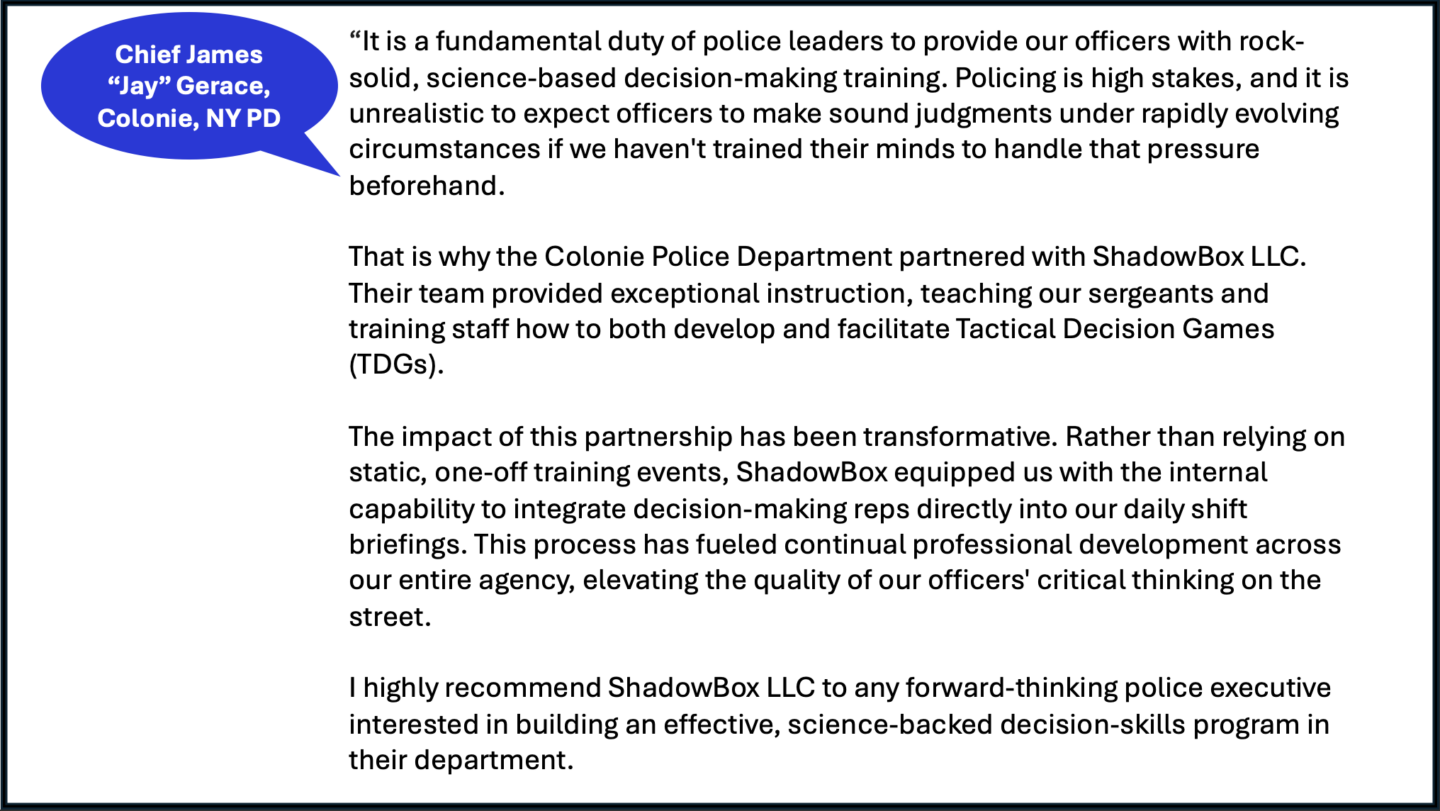
The challenge for many agencies is not in recognizing the value of this type of training; it is creating a sustainable way to develop and deliver it. The training is most impactful when it is grounded in the local department’s distinct resources, geography, and operational realities. The Colonie, NY Police Department recognized that the best solution would be to train their own staff to become skilled scenario developers and facilitators. Our team helped a group of their officers practice creating realistic, discussion-based training scenarios from their own experiences and facilitating productive conversations around them. We worked collaboratively with participants to refine each scenario, coach facilitation techniques, and provide structured feedback as officers practiced leading discussions with their peers. In one case, a TDG developed through the project led to the creation of a new policy for handling a challenging type of incident where no guidance had previously existed.
Cognitive skills benefit from frequent practice. Rather than treating decision-making training as an occasional standalone event, shorter scenario-based exercises can create recurring opportunities for officers to practice, reflect, and learn before they get in the field.
Podcasts
On The Trainer’s Bullpen Podcast, in Episode 52, our CEO John Schmitt discusses why law enforcement training should exercise the cognitive skills officers need to make difficult decisions in the field. In Episode 59, Colonie Police Chief Jay Gerace shares how his department is rethinking traditional training by creating short, recurring opportunities to incorporate knowledge, physical skills, and decision making into officers’ regular routines.
Want the highlights? Read our recent blog Training That Sticks: Two Conversations on Rethinking Law Enforcement Decision-Making Training.